$1,000,000,000,000's isn't worth $30/month.
By Alexander Gibson
August 5, 2026
Trillions of dollars are being spent on AI [1]. So much so that Alphabet (Google’s parent company) has just had its first quarter of negative free cash flow in its publicly trading history [2]. Trillions more to come [3], it’s all in on AI!
Given all this spending, I’m yet to use any amount of my own money on AI. The $30/month subscriptions are not worth it for me, and on this realisation, I’ve needed to pause and reflect on the use cases and hype around AI.
There are an exhaustive amount of opinion pieces on AI floating in the ether, so this hopefully will be my one and only. My following thought’s stem from myself as a PhD student in metascience, not a senior scientist. It’s obvious to me we will have further financial bubbles in the future. Few, if any reasons suggest economic conditions have become favorable for a continued and prosperous future without downturn. Just last month the South Korean market fell around 40% from capital concentration, skepticism on AI and over leveraged retail investors being margin called on ETF debt. That being said, I have no crystal ball, nor am I trained as an economist.
I did not exist during the 2000 Dot Com Bubble.
Quite simply I did not exist during crash of the Dot Com Bubble in March of 2000. United States stock prices rose dramatically in the preceding years before their subsequent demise with the SNP 500 (largest 500 public companies in the USA) falling around 50% over the following two years. The Nasdaq fell nearly 80%. A measure for how expensive a company is, can be expressed by the cyclically adjusted price to earnings ratio (CAPE ratio) which reached a peak of 44.19 in December of 1999, three months before the crash. Another (retrospective) alarm bell during the Dot Com era was the concentration of capital in fewer companies. At the peak, the top 10 largest companies in the US made up 27% of the SNP 500.
Currently, the CAPE ratio sits at 42.28 [4]. The most expensive US stock market in history outside the Dot Com bubble. The 10 largest US companies now make up 40% of the SNP 500. Far more concentrated than the Dot Com bubble.
That’s however only two components of a large global economic system. Another period in history (one that I was alive for), was the Great Financial Crisis (GFC) which came to fruition in part by the US housing bubble marked by large volumes of debt. During times of economic pressures and high inflationary environments, people cut back spending. Related to the housing market, people may seek help with mortgage repayments as interest rates climb, and debt needs to be repaid. What ensued was a liquidity crisis as asset valuations collapsed, debts were margin called and could not be repaid.
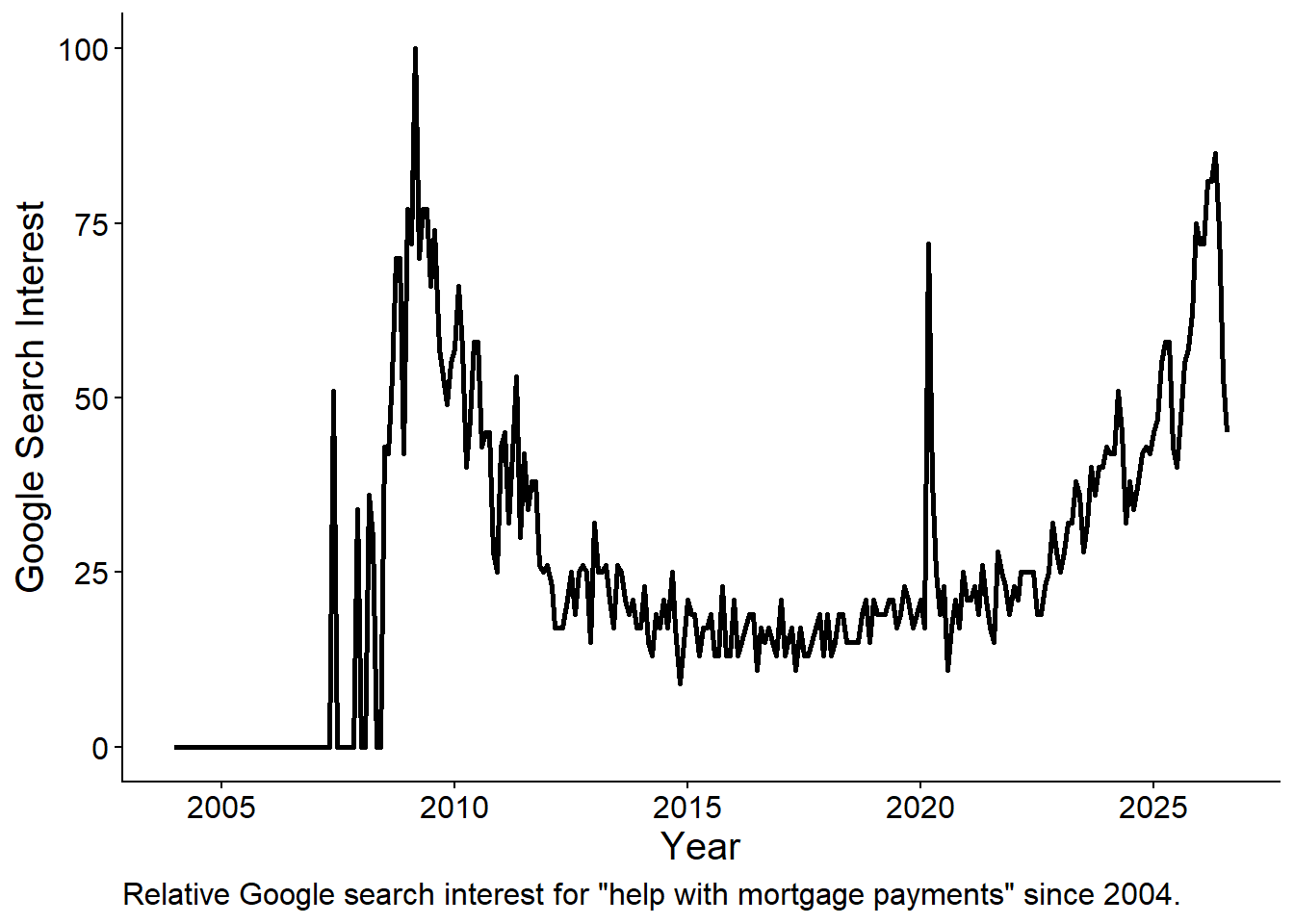
At this point in time Google was widely used and search results were being stored. Since 2006 Google Trends allows anyone to search for the popularity of searches. We can use this to examine patterns in what people search over time across the world. One thing a homeowner might search during troubled financial times is “help with mortgage payments”. During the GFC, “help with mortgage payments” reached its peak interest on Google in March 2009. During COVID there was another peak when unemployment rose and people lost income. Now in May 2026, interest by Google searches for “help with mortgage payments” peaked higher than COVID and nearly at GFC levels.There also pears to be a seasonal trend with low periods of searches during mid-year which may explain the recent dip.
On the other hand, we can look at what a trader might do under signs of economic overvaluations. Famously, Michael Burry took large bets out on credit default swaps against subprime mortgage bonds in the US housing market. To do so he made a short sell against the US housing market, making a mere $700 million in return. His trade and the events leading up to the GFC was famously adapted into “The Big Short” (recommended watch).
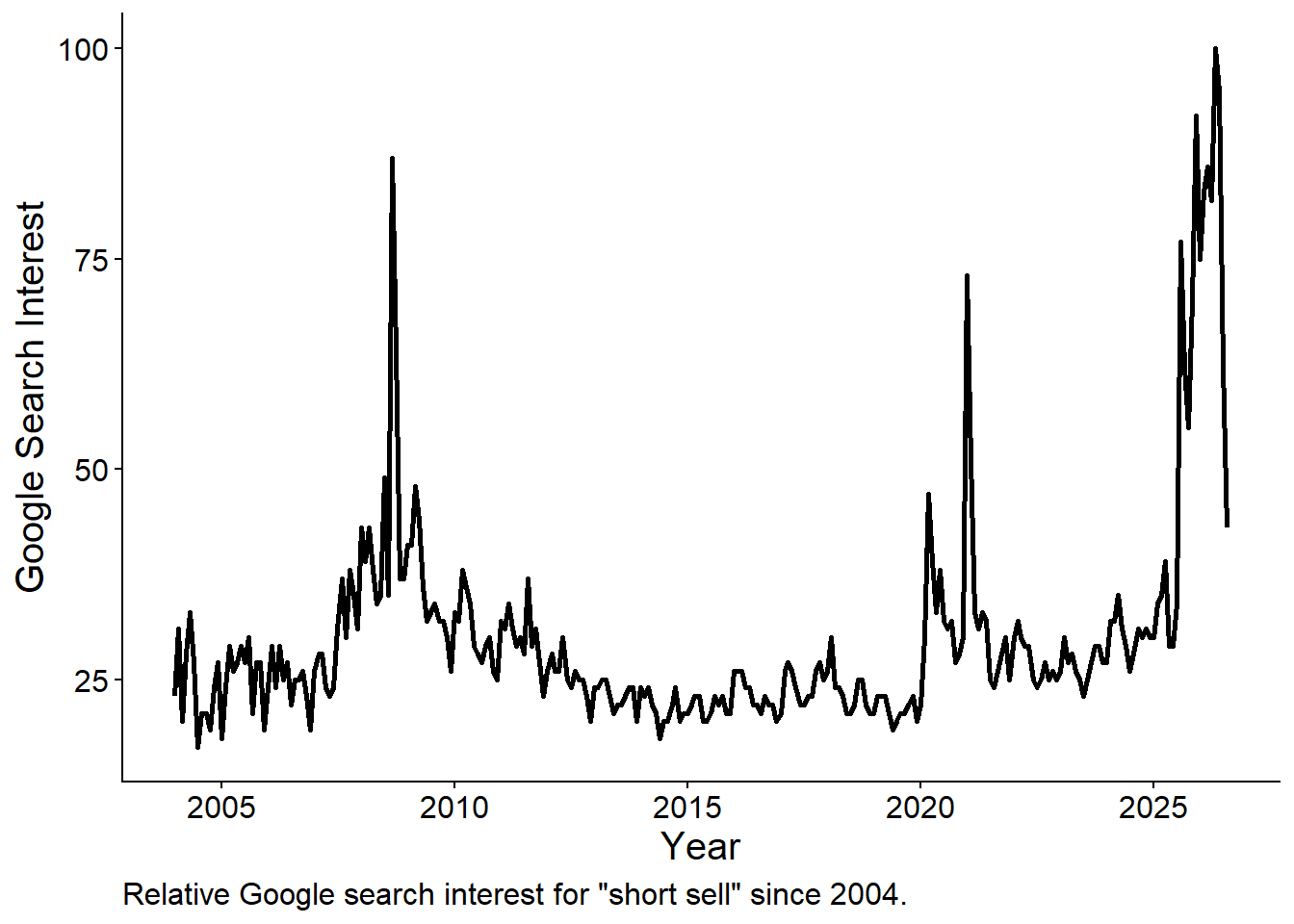
Investment bankers, traders and analysts could be interested, much like Michael Burry was, in short selling investments where valuations are higher than underlying fundamentals. Yet again, using Google Trends for current interest for “short sell” peaked higher than the GFC and COVID. There is a notable recent decline in search interest so these sudo-indicators can’t be expected to tell the whole story as many other factors influence housing costs, and terminology for “short sell” may include new interests not previously account for.
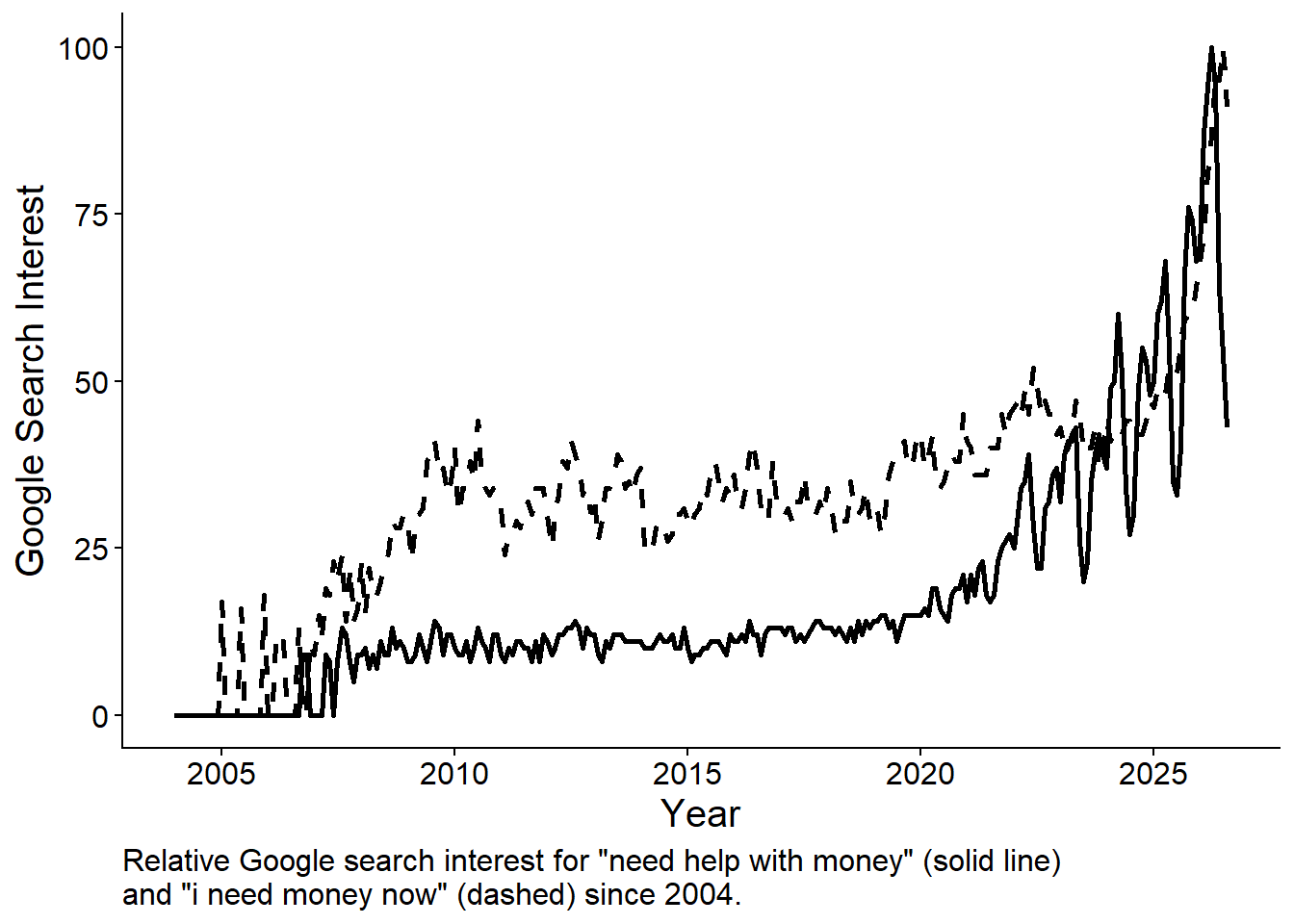
For the average person though there seems to be more financial pressures than before as well. Searches for “need help with money” and “I need money now” are each at peak interests. Much like help with mortgage payments, help with money appears to be seasonal and in a lull around mid-year, which could be expected to climb again towards the end of the year.
So, what we currently have, is both the largest US concentration of capital in the most expensive US market since the Dot Com Bubble. Along with a global interest for help with mortgage payments and money, and more interest in short selling stocks than ever before. Put together under a backing of trillions worth of spend into AI investment, it does bring worry. Not only is there record spend, but supposedly the beginnings of structured investment vehicles with an additional $1.65 trillion of debt are sitting off financial balance sheets. [5]. I too would offload risk if I had fiduciary obligations to shareholders and needed money. Similar structured investment vehicles played a role in the GFC.
On May 11, 2026 OpenAI released their Signals Consumer Data report [6]. A complied list of 119 countries ranked on ChatGPT messages per capita. Australia ranked 17 out of the 119 countries for use, ranking higher than the USA at 29. Australians love ChattyG! Recently, on July 8, 2026 the Australian Government released the “AI and employment in Australia report” [7]. The first key point “There is no evidence to date of broad AI-driven labour-market upheaval in Australia.” Between the pre-ChatGPT era and February 2026, jobs with an exposure risk to AI one standard deviation above average, saw employment fall by only 2%. Not much change.
Nobel Prize laureate and godfather of AI Geoffrey Hinton said back in 2016, “people should stop training radiologist now”. At the beginning of this year the American College of Radiology identified a radiologist shortage [8]. There is demand for radiologists a decade later.
Both the relatively stable employment for AI exposed Australian jobs and radiologist shortage as examples, lead to a potential indication of Jevons Paradox at play. As technological improvements lead to increased efficiencies one may think you’ll achieve the same output for less cost. What occurs is an increased demand for these tools as more can be done for the same previous costs. We have seen that more research is being published, but arguably, this work may not be of any higher quality. Going all the way to James Watt (supposedly one of my great grandfathers), his improvement of the steam engine saw the Railway Mania bubble of the 1840’s as increased efficiencies drove demand. That too was a practical and physical invention that changed how the world operated.
One of the first AI companies to go to market in an initial public offering (IPO) was SpaceX. At its peak SpaceX was worth $2.6 trillion. The Australian Government values Australia’s entire broadacre farmland at $1.5 trillion [9]. A difference between the two is that SpaceX hasn’t generated any profit. Since the peak SpaceX has fallen more than 50%. Reflective scepticism with AI in the South Korean market saw a nearly 40% fall in the KOSPI index spurred by overvaluations, capital concentrations and debt. Japan’s Nikkei 225 fell 15% and are the largest external holder of US treasury bonds. Days ago, the US, just bought the Japanese currency for the first time in more than a decade to strengthen the weakening Yen [10].
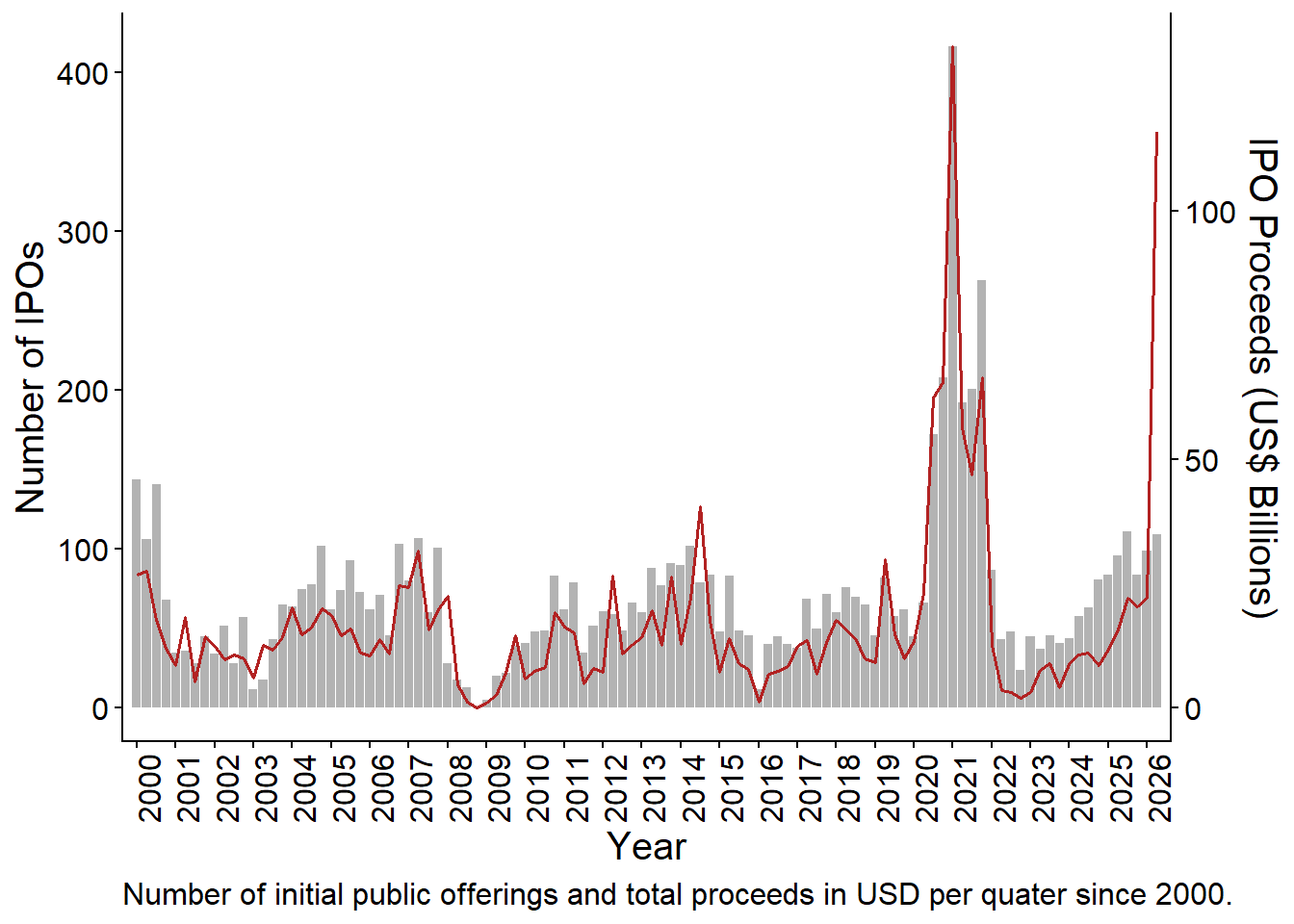
The United States Securities and Exchange Commission publicly publish IPO listings from 2000 to 2026 [11]. Private investors would, presumably like to sell high. To do so, a company would need to go public. Again there are similar levels of IPO’s to the Dot Com bubble and GFC. Most dramatically though is the current discrepancy and divergence between volume of IPOs and financial proceeds. I too would want to sell when valuations are at their highest.
But there is promise. OpenAI in May announced they disproved a central conjecture in discrete geometry and more recently ten new advances in mathematics and theoretical computer science. These works have really made a stir in the science world, and I even am unsure what this will mean going forward. I use Claude to help myself write code and check for typos in my written work (I have not used any AI for this blog). But in my day to day, it’s just a time saver. AI is simply a tool that allows me to do what I could already do faster. And if prices go up to recoup costs or repay debts, I doubt I’ll be jumping at the gun to spend more for something I don’t already pay for.
On the contrary, a provoking thought experiment I read on Sub Stack the other day (apologies I forgot the user and can’t give credit) brought in the library of babble. A theoretical (real?) concept of a library containing every single written work to have existed or that will ever exist. Yet, this concept does not prevent writers from beginning works of art nor prevent us from starting written expressions of our human experience. If we envision a future where all problems are “solved” by AI, it leaves us at a point to decide what it means for our lives. The 1979 IBM training manual said it best “A computer can never be held accountable, therefore a computer must never make a management decision”. This is because a human is always in the loop. If an AI tool makes a mistake or causes harm, a human either began that process or failed to intervene. What we make of it matters.
Another statement I keep seeing is that “these models are the worst they’ll ever be”. I don’t solely buy that argument as the enshittification of the internet is also in full force and is definately no better than it was years ago. “The internet is the worst it will ever be” certainly does not hold up. AI slop has a role to play in that. Besides that point, the same exclamation can be placed to free and open-source large language models, “they’re the worst they’ll ever be”. I don’t need the best model for everyday work, these are tools that can help, but an open source free model might just cut it for the majority work I’ll ever do.
At the end of all this though you may be thinking, “yeah but this time is different, AI is really going to change everything, we’re making leaps and bounds in productivity and science”. But, there is no evidence to suggest so in the Australian job market as of yet and a company worth as much as Australia’s broadacre farmland has a product called Grok… Tools like ChattyG simply have just not changed my life that much and I don’t think genuine day to day life has changed for many people.
And now having spent the last two years of my PhD in metascience studying prediction models, there is one thing I can tell you. That it’s bloody damn hard to predict the future. This all could be one of the best things to happen to humanity if taken in the right direction. But what I do know however, is there will be another financial bubble and/or recession at some point in the future. When will that be? I could not tell you.
If this time is different, a great book and reminder could be called upon: “This Time Is Different: Eight Centuries of Financial Folly”. There is no question AI will change the world and much like the Dot Com era, we now embed the internet and its ecosystem into every crevice of our lives. The world has and will change. I hope for the day where AI really has a profound impact on my day to day life. Till then, the $30 a month subscription isn’t worth it.
- Posted on:
- August 5, 2026
- Length:
- 10 minute read, 2088 words
- See Also: